Thomas Michael Kettle (9th Feb 1880- 9 Sept 1916), born near Swords of a distinguished Irish nationalist family, was a barrister, journalist, economist, poet and Irish parliamentary MP for East Tyrone (1906-1910). Kettle’s father, Andrew Kettle (born Drynam Hse, Swords 1833), was a major Irish Nationalist politician of that day, considered by many to be ‘Parnell’s right-hand man’.
Thomas Kettle was a distinguished member of that progressive group of Irish intellectuals who held a new, European vision of what Ireland’s destiny was to be. James Joyce considered Kettle to be his best Irish friend. Privately educated, Kettle went on to study at UCD where he distinguished himself as a brilliant scholar and orator. Elected President of the prestigious Literary and Historical Society there, he was supported by famous contemporaries such as Francis Sheehy-Skeffington and Oliver St John Gogarty.
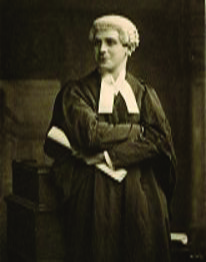
The earlier photo shows Kettle in his legal robes on the occasion of being called to the Irish bar (1905).In 1908 he became Prof. of Economic Studies at UCD, representing Ireland at many important European conferences and meetings. Both a Nationalist and a Europhile, Kettle consistently campaigned on behalf of oppressed minorities, echoing the humanitarian campaigns of his contemporary Roger Casement .Kettle actively supported the Dublin worker’s strike of 1913, wielding his journalistic pen skilfully on their behalf.
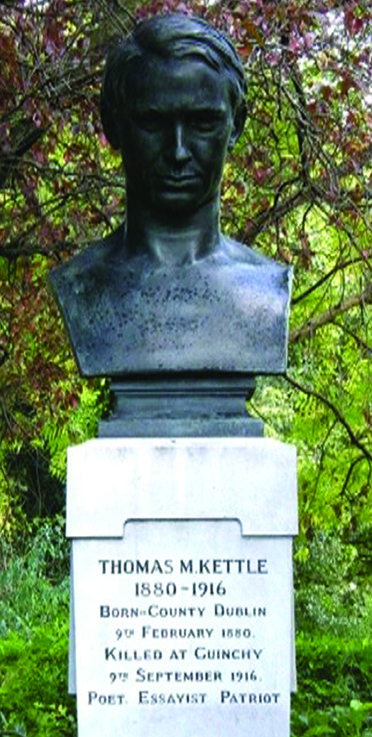
Kettle’s bronze bust in St Stephen’s Green by sculptor Albert Power though completed in 1921, was only finally erected in 1937. Service in the British army was dimly viewed by the Irish Free State Authorities of that day, occasioning this delay.
Tom Kettle was undoubtedly one of the most talented men ever too walk the streets of Swords. Rather in the mode of Michael Collins later, his premature death at 36 years was an irreparable loss for Swords, for Fingal, and for Ireland too.